

Article Summary: Camping Dry Tortugas Rats, Dry Tortugas Camping Reservations, Camping at Fort Jefferson, Camping in Dry Tortugas National Park
While a day trip to Dry Tortugas offers its own beauty and seclusion, nothing will compare to camping at Dry Tortugas National Park.
Dry Tortugas is notoriously known as one of the best places to camp in the United States. It’s recognized for its natural beauty, historic significance, and remote location, making it a very exclusive campground.
As long as you plan ahead and understand the process, you’ll have the experience of a lifetime.
This is the ultimate guide for securing your camping reservations and planning your overnight trip to Dry Tortugas National Park.
This post may contain affiliate links. If you make a purchase, I may earn a small commission at no additional cost to you. For more information, view my privacy policy.
Table of Contents
How Does Camping at Dry Tortugas Work?

The way the campground is managed at Dry Tortugas National Park is a little unusual.
Despite limited availability on the ferry, the most popular way to get to Dry Tortugas and Garden Key, the campground itself is operated on a first-come, first-served basis.
This is for people who arrive on Garden Key in their personal vessels and wish to camp. There are only ten slots per day available for campers in each direction on the ferry, which means there is indeed a limit if this is your only transportation option.
The Dry Tortugas website says, “All campers, once they arrive, will be guaranteed a place to camp” and, “reservations are not required for the 6-person sites”. However, reservations are required if you don’t have your own boat because you have to get there.
So, in order to guarantee your camping reservation, you need to book the Yankee Freedom ferry as far in advance as possible. Effectively, this is your camping reservation.
How to Make Dry Tortugas Camping Reservations

I cannot stress this enough: book your trip to Dry Tortugas as soon as you know when you will be traveling. Plan the rest of your vacation around the dates you are able to secure. The website recommends booking 8 to 12 months in advance!
You can visit during a less-crowded time of year to help your chances of finding a camping spot.
If you call and the dates you’re interested in are already taken, keep calling to check for cancellations. This is how I was lucky enough to camp at Dry Tortugas. For my trip in January 2020, I called in November 2019 and everything was fully booked. I called again in December, and two spots had become available. Be resilient and keep trying!
There is no standby for camping reservations. Once you arrive, you have no chance of camping on Garden Key unless you manage to secure your own vessel.
Camping reservations for the ferry must be made over the phone (for a day trip, you can also book online).
Phone Number: 800-634-0939
Group Site: If you’re interested in reserving the group site (more than ten people), the process is different. Before reserving the ferry, you must fill out an application with the National Park Service. You can call (305) 242-7700 to reserve or visit this page. The camping fee for the group site is $30.
How to Get to Dry Tortugas National Park

The most important part of your camping trip is getting to Garden Key where the Dry Tortugas National Park campground is located.
The island is about 70 miles away from Key West. There are only two ways to get there: a boat or seaplane. Most visitors arrive on the Yankee Freedom Ferry, the only authorized ferry concessionaire for the National Park Service at Dry Tortugas.
The information below details how to reserve boats and planes to visit Dry Tortugas. If you plan on arriving on your own private boat or plane, the process is different. For information on arriving on a private vessel and acquiring a boat permit, click here. For information on special-use permits for private seaplanes, click here.

Booking the Yankee Freedom Ferry from Key West

When you’re calling ahead to book your campground reservation, what you’re actually doing is reserving a spot on the ferry. Once that is secured, you’re guaranteed a place to camp on the island.
Once again, I’d like to reiterate that booking as far in advance as possible is advised.
Camping reservations cannot be made online – you have to call the Yankee Freedom office at 800-634-0939 to check availability. Subject to availability, you may spend up to three nights (four days) camping at Dry Tortugas.
Yankee Freedom Ferry Details
Cost: Camping is $200 per adult. This includes the National Park entrance fee, but not the camping fee. I’ll discuss camping costs more in the next section. For more information about rates, click here.
Inclusions: Included with the ferry ticket is snorkeling gear as well as one breakfast and one lunch. You can choose to receive your lunch on the day you arrive or the day you depart. You can also pay $7 to eat at the lunch buffet again if you’ve already had your included lunch.
Phone Number: 800-634-0939
Book Online (day trips only): click here
Parking: There is a city parking garage located at 300 Grinnell Street, across from the ferry terminal. It costs $32 per day to park here.
Address: The ferry terminal where you will check in and board the ferry at 100 Grinnell Street.
Duration: The ferry ride is about 2 hours and 30 minutes each way. Typically, you’ll depart at 8 a.m. and return to Key West around 5:30 p.m. This is subject to change due to the weather.
Check-in: Campers are required to check in by 6:30 a.m. on the morning of departure to load their gear. Your gear will be thoroughly searched to ensure compliance with the rules. Expect staff to inspect your gear before you are permitted to load it onto the ferry or check in.
Yankee Freedom Ferry Official Website: click here
Dry Tortugas National Park Official Website: click here
Reserving a Seaplane

If you’re camping at Dry Tortugas, you cannot take a plane. The only authorized seaplane service will not transport camping gear. However, if you’re interested in booking a plane for a separate day trip to Dry Tortugas, here are the details.
As with Yankee Freedom, there is only one authorized tour company for flights to Garden Key.
There are two options for arriving via seaplane: half-day or full-day sightseeing flights. Advance reservations for both are required.
Cost: $356 per adult for a half-day or $625 per adult for a full day. This does not include the $15 park entrance fee, which you must pay in cash when you check in (or show your America the Beautiful pass).
Duration: The flight is about 40 minutes each way. On the half-day trip, you can expect about 2.5-hours of island time. On the full-day trip, this is extended to 6.5 hours.
Departures: There are half-day trips in the morning and afternoon. For full-day trips, the only option is a morning departure.
Official Website & Booking: click here
Returning to Key West
After camping at Dry Tortugas, make sure you clean up your campsite by 10 a.m. on the day you depart.
You should have all of your gear on the dock by 10:30 a.m. to be loaded back onto the ferry. You must clean as much of the sand off as possible before it is loaded onto the boat.
Keep any items you need for the day on your person as you may not be able to access them once they are back on the boat.

How Much Does it Cost to Camp at Dry Tortugas?
There are multiple fees associated with camping at Dry Tortugas National Park. Here is the breakdown:

Entrance Fee: First, it costs $15 per person to enter Dry Tortugas National Park. This is included in the price of your ferry ticket. You will be charged the fee when you purchase a ferry ticket, either online or over the phone. If you have an America the Beautiful pass, show it upon arrival at the ferry terminal to receive a refund. This fee is valid for 7 days.
Camping Fee: It costs $15 per campsite to camp at Dry Tortugas. If you’ve reserved the group site, it costs $30 for your group. This is payable upon arrival at a self-service station in the campground. If you’re an Access Pass-holder or a Lifetime Senior Pass-holder, your camping rate is discounted. Make sure you bring cash to make this payment when you arrive. Credit/debit cards are not accepted.
Ferry Ticket: Most important is your ferry ticket. For campers, the ferry costs $185 per person. When you purchase a ticket, you will be charged $200 to include the park entrance fee.
Facilities and Services at Dry Tortugas National Park
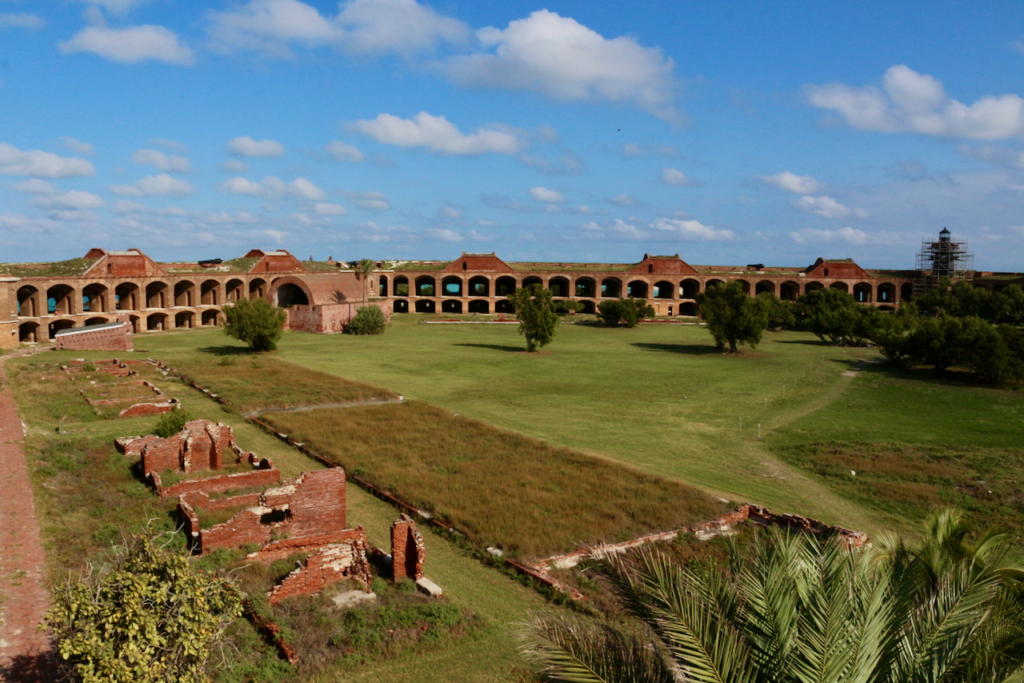
Water: There is no potable water on the island. Be sure to bring plenty for your group, especially if you are camping. It’s recommended that you bring one gallon of water per person per day.
Changing rooms: There are changing rooms available on the island. You can, of course, also use your tent.
Toilets: The island does have public pit toilets. However, when the ferry is docked, these are locked and all visitors are required to use the toilets on the ferry. This helps limit the environmental impact on the island itself by leaving less waste behind. Toilet paper is provided, but there are no sinks. There are hand sanitizer dispensers.
Food: You must bring all the food you want to eat with you. You will have one breakfast and one lunch provided by the ferry. Other than that, you are on your own (unless you pay an extra $7 every time you’d like to eat at the ferry lunch buffet). There is no food available for purchase while camping at Dry Tortugas.
Cooking: There are grills in the campground at Dry Tortugas. However, you need to bring your own charcoal. You are not allowed to transport fuel on the ferry, so I wouldn’t bother with transporting your own stove.
Trash: There are no trash receptacles on the island of Garden Key. Everything that you bring must be packed out again. The ferry service will provide you with a large trash bag when you check in.
Camping in the Dry Tortugas with Hungry Rats
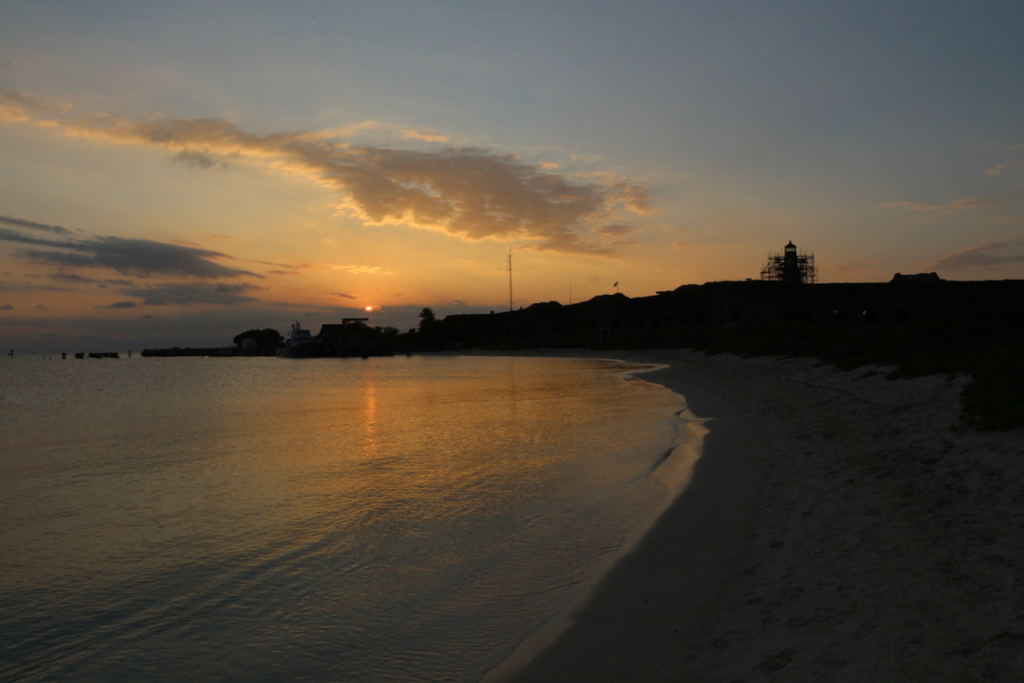
There are wild rats on the island that have, unfortunately, become humanized. That means they have become reliant on human food and will go to great means to retrieve it.
There are wooden posts to hang your food from, however, the rats can climb these. The best way to protect your food and belongings is to bring large plastic containers or borrow them at the campground upon arrival. Make sure these are tightly closed and store them outside of your tent.
Many other campers during our visit had their tents broken into or bags shredded when the Dry Tortugas rats came after their food at night. When we were getting up from our picnic table after dinner, we saw a rat scurrying away. Be rat-aware!
Things to Do While Camping in Dry Tortugas National Park
Whether you take a day trip or plan on camping at Dry Tortugas, there are plenty of things to do in Dry Tortugas National Park.
Birdwatching
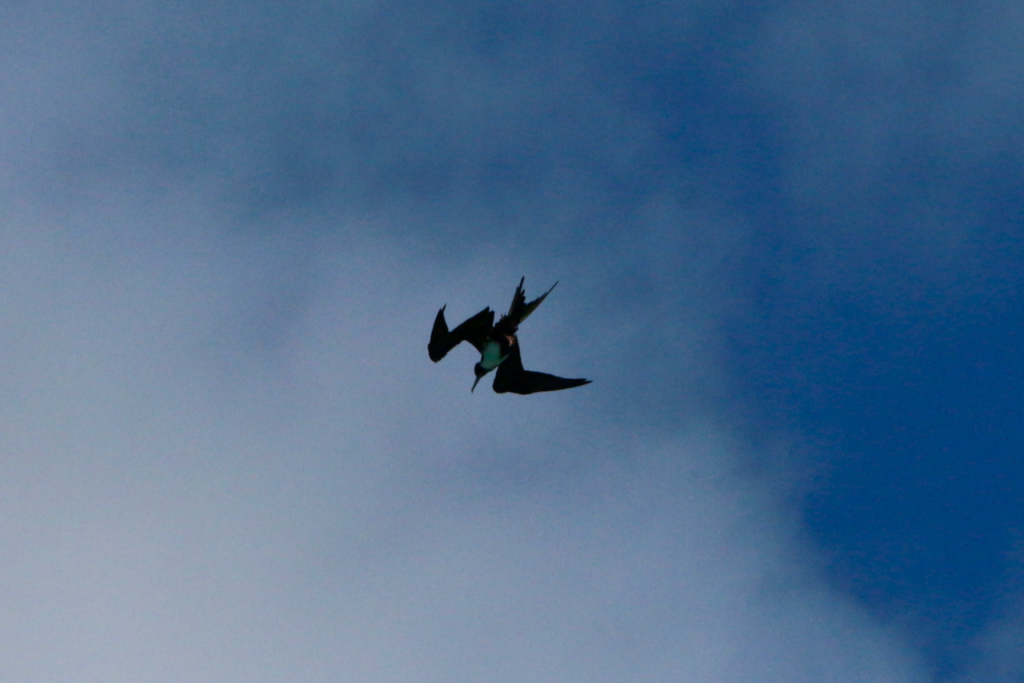
The park has many migratory bird species, but two of its most famous are the Magnificent Frigate Bird and the Sooty Tern.
Both species return every year to nest in the Dry Tortugas, their only nesting location in the continental United States.
If birdwatching is one of your primary reasons to visit, plan your trip during Spring or Fall migration.

In the photo above, you can see two keys connected to Garden Key where Fort Jefferson is located.
You can walk along the shores of Bush Key, closest to Garden Key, but you’ll see closed signs as you approach Long Key farther out. This is where the birds are nesting, and visitors are not allowed on the island in order to protect the nests.
You can see both species above as well as hundreds of others on Garden Key as well.
Fort Jefferson Tour

Every day at 11 a.m., a staff member from the Yankee Freedom will provide a tour of Fort Jefferson. Typically, this includes a short, introductory 20-minute talk followed by a longer, more detailed tour of the fort that lasts about one hour. You can choose to participate in both tours, one tour, or neither tour.
There is also a self-guided tour you can download to your phone prior to arriving. Remember, there is no cell service or WiFi on the island. You need to download the tour to your phone prior to arriving in order to access it once you get there.
Kayaking
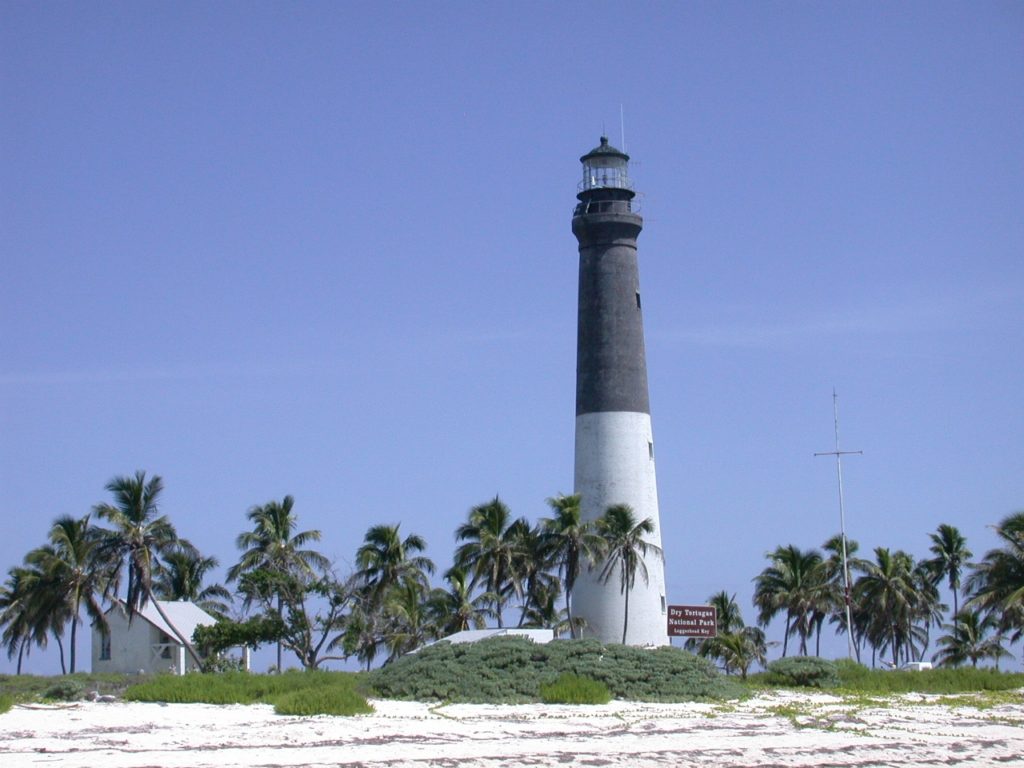
One of the things I’d love to do on my next visit to Dry Tortugas is bring a kayak. The ferry allows them onboard, and you can launch them from the dingy area on Garden Key. That way, you can explore some of the other islands.
The closest is Loggerhead Key, just 3 miles from Garden Key and featuring a picturesque lighthouse. If you have more time in Dry Tortugas, I’d highly recommend checking it out for even more isolation.
One of the rangers on the island told us that the snorkeling is incredible there and includes an area known as Little Africa.
Photography
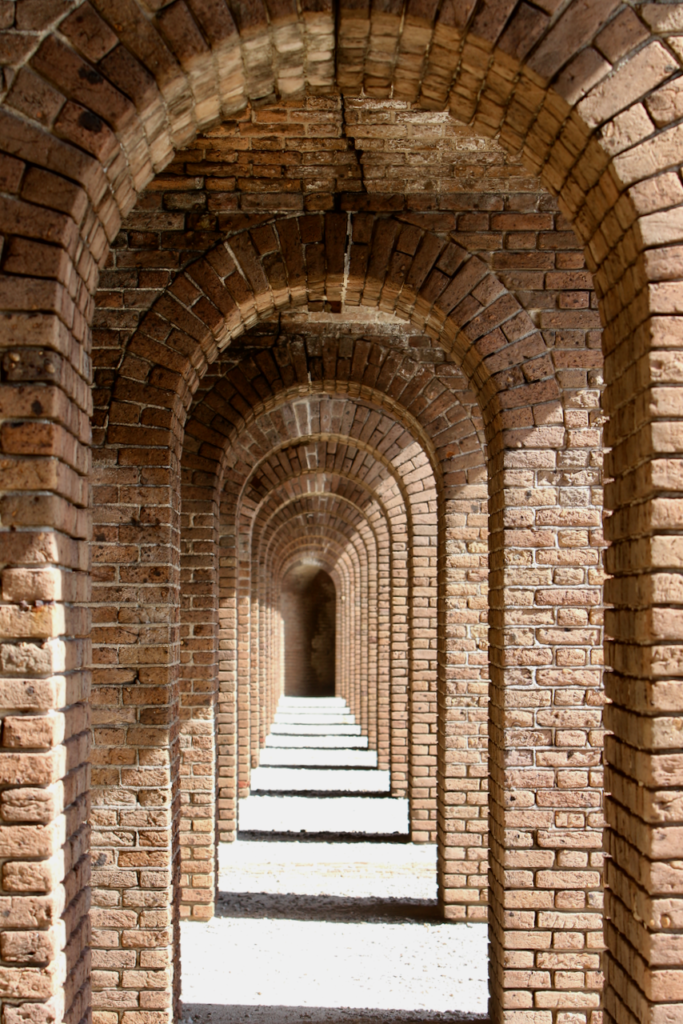
There are endless opportunities for photographing the beauty of Garden Key.
When camping at Dry Tortugas, one of the greatest pleasures is having the island mostly to yourself when the planes and ferry all depart for the day.
Walking the moat wall was one of my favorite places to take photos. The roof of the fort and its arched hallways are also major highlights.
Snorkeling
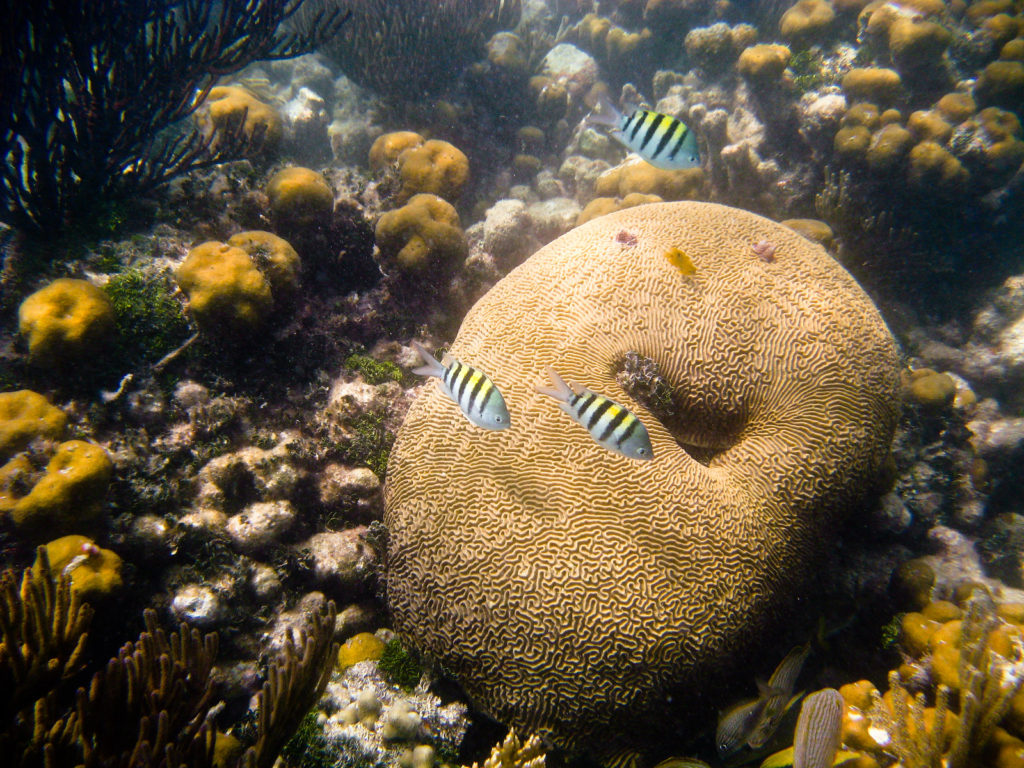
One of the most popular reasons for visiting Dry Tortugas is to witness the underwater wonders.
If you aren’t interested in snorkeling, the waters are clear and we saw plenty by walking the moat wall and beaches. But the best way to see what lies beneath the surface is absolutely to swim along with the treasures found here.
You can snorkel and swim off the shore of two beaches on Garden Key, north beach and south beach. You can bring your own gear, rent from locations in Key West, or borrow gear from the Yankee Freedom ferry (included with your ticket). They will allow you to keep the gear you borrow for the duration of your camping trip.
Stargazing

With almost no light pollution in the Dry Tortugas, the uninterrupted night skies are absolutely stunning. Hopefully, you’ll be lucky enough to camp in the Dry Tortugas on at least one clear night.
My night-sky photos are pretty amateur and don’t do the scene justice whatsoever. We could actually see the Milky Way stretching its way across the sky above Fort Jefferson.
Wildlife Watching

The wildlife is sensational in the Dry Tortugas. While camping, we saw hundreds of hermit crabs on Garden Key. They crawl all over the campground, so use a headlamp at night to make sure you don’t step on any!

We also had the pleasure of seeing four sea turtles. The best viewing was the one photographed above, which we saw in the moat. We had a super clear view as it swam away. The others we saw were all swimming in the open ocean and we saw their heads pop up to the surface.
These are all in addition to the birds, of course. Also, don’t forget to watch for dolphins on the ferry ride. Lastly, sometimes you can find crocodiles in the moat, too!
Fun Facts About Dry Tortugas National Park

- While time matters very little in such an isolated area, the islands are actually located in the Central Time Zone. If you take a seaplane to the park, you’ll land 15 minutes before you took off from Key West!
- Fort Jefferson was never completed despite more than 16,000,000 bricks going into its construction. It’s also the largest brick structure in the Western Hemisphere.
- Dry Tortugas National Park is part of the Everglades & Dry Tortugas Biosphere Reserve.
- Most visitors stick to Garden Key, where you’ll find the campground and Fort Jefferson. In total, Dry Tortugas National Park encompasses seven islands.
- Fort Jefferson had many purposes but is most-known as a prison (even though it was never intended to be one). Its most famous prisoner was Dr. Samuel Mudd, who assisted John Wilkes Booth after he assassinated President Abraham Lincoln in 1865. He was sentenced to life imprisonment at Fort Jefferson after setting Wilkes’ broken leg and harboring him for days as he healed. Four years into this life sentence, he received a pardon when he saved individuals on the island suffering from a yellow fever epidemic.
- The name Dry Tortugas came to be after Ponce De Leon, the first human to see the islands, found 160 turtles here and named the islands Las Tortugas. The “Dry” was added later, inspired by the fact that no freshwater is available.
- Ernest Hemingway spent a lot of his free time fishing in the area we now know as Dry Tortugas National Park.
- Fort Jefferson National Monument was first established in 1935. The park was expanded in 1983 and redesignated as Dry Tortugas National Park in 1992.
What to Pack for Camping at Dry Tortugas
As you have seen, you should be prepared for a very remote experience. There are extremely limited services available on the island. Plan to be completely self-sufficient upon arrival and bring everything you need with you, then prepare to take it all back with you as well.
You are limited to 60 pounds of supplies.
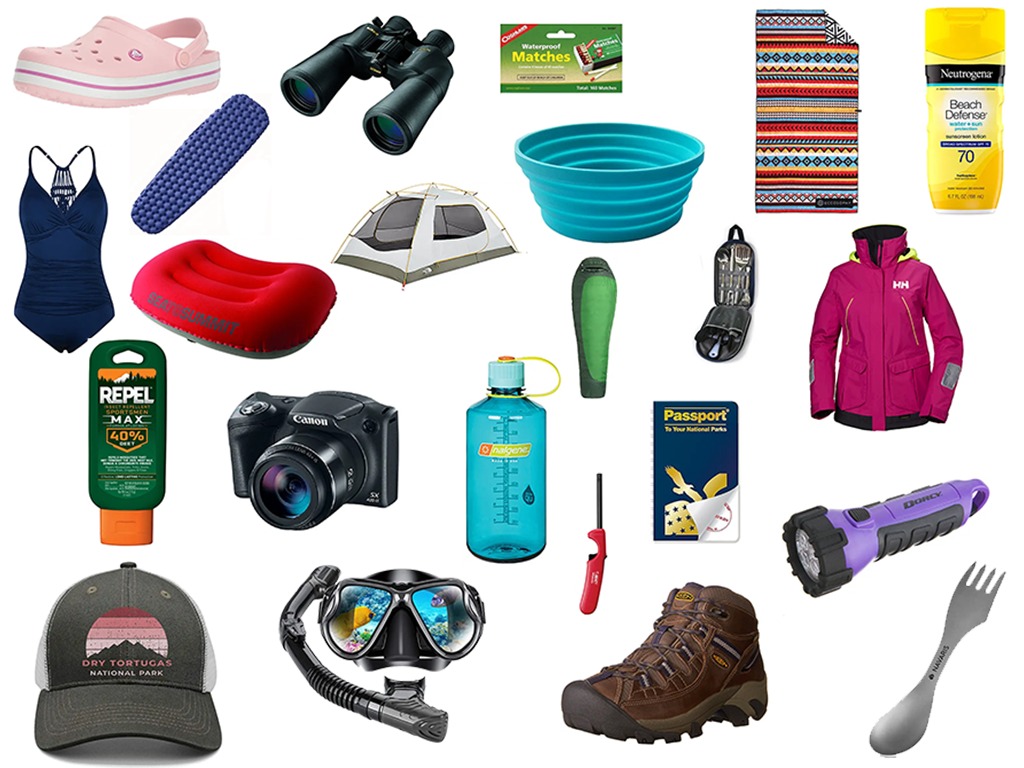
- Cash to pay the camping fee ($15) and (optional) ferry crew gratuities. There is also a small store on the island that sells souvenirs. They do accept credit/debit cards, but their internet can be unreliable.
- Food: The ferry only provides one breakfast and one lunch. Other than that, you must bring your own meals and snacks.
- Self-starting charcoal: If you plan to cook, this is the only method. There is no fuel allowed on the ferry. Grills are provided in the campground.
- Cookware: spork, bowl, cup, water bottle
- Tent: required – you cannot camp without a tent. No hammocks are allowed.
- Ground cover or tarp
- Rainfly
- Sleeping bag or liner, blankets, sheets, etc.
- Sleeping pad
- Pillow
- Water: there is no potable water available on the island. One gallon per person per day is recommended. You may also transport alcohol (obviously, you must be 21+ years old to partake). After 2 p.m., the ferry will open a bar and serve alcohol as well; any alcohol purchased onboard must remain on the ferry. If you wish to drink alcohol on the island, you must transport it there yourself.
- Cooler with ice (optional)
- Camera
- Snorkeling gear: You can bring your own or rent in Key West. The ferry also provides gear, and rentals are included with your ticket. You may keep the gear overnight if you’re camping.
- Swimsuit
- Extra dry clothes to change into
- Towel
- Comfortable footwear: Consider tennis shoes or hiking boots and a pair of sandals or flip-flops.
- A book to read or other things to entertain yourself during downtime.
- Binoculars
- Passport book for collecting your national park stamps.
- Rain gear: Consider an umbrella, rain jacket, and rain pants. Thankfully, thunderstorms are unlikely at Dry Tortugas.
- A light jacket: It can be chilly in the evenings. You should also prepare for windy conditions.
- Sun protection: sunscreen, sunglasses, hat
- Garbage bags: Prepare to pack out everything you bring in and all the trash you create. The ferry will provide one large bag for campers.
- Hand sanitizer: There are no sinks in the bathrooms, but they do have dispensers. I like to play it safe and bring a small travel-size one with me as well.
- Toilet paper: This is provided, but it doesn’t hurt to bring extra just in case.
- Light source: flashlight, headlamp, and/or lantern and extra batteries
- Insect repellant: Mosquitoes are rare, but there may be other insects about and you should be prepared.
- Personal items: Think about little things you might need like medications, contact solution, glasses, toothpaste, toothbrush, etc.
- Storage container: Your gear can get wet on the boat or in inclement weather on the island. It’s recommended that you bring a container to protect it. There are also some on the island available for you to use.
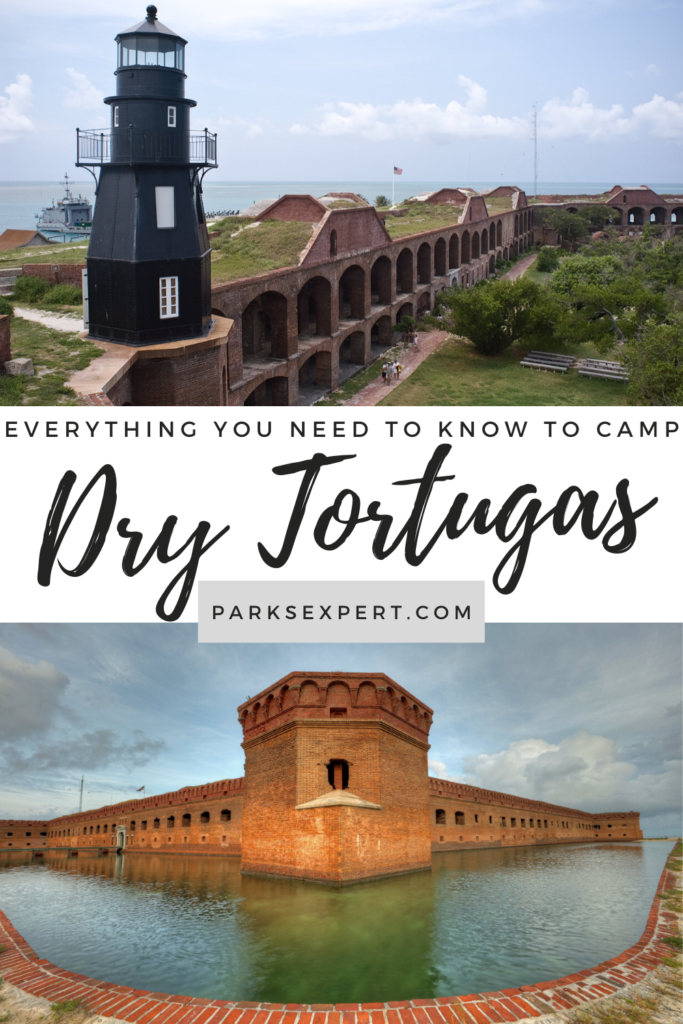
Pin Camping at Dry Tortugas National Park


Dry Tortugas National Park Pennant

Fodor’s Guide to the 63 National Parks

Women’s National Parks Checklist T-Shirt

Women’s National Parks Checklist T-Shirt

Map of National Parks T-Shirt

Dry Tortugas National Park Sticker


What an amazing experience to camp on Garden Key! Your post is so full of helpful information that I never would have figured out on my own. Seems like it was worth all the extra effort too, although I’m not sure about camping with rats.
As long as you pack up your food and you’re careful with your crumbs, the rats aren’t a problem.
Amazing!!! This is in my bucket list this year! I’m in Orlando so it should be fairly easy to get there! Haha thanks for all the tips! I’ll be referring back to this when I go!
Definitely! You just have to do it; I lived in Orlando most of my life and it took me soooo long to get there.