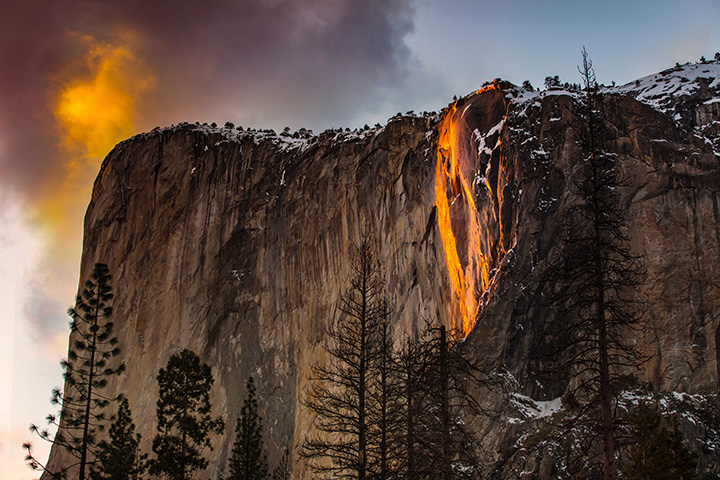
Witness the wonder of the Yosemite Firefall! The Horsetail Fall Firefall is one of nature’s most spectacular displays. Every year, during a certain window of time, visitors can enjoy a natural spectacle as fiery water cascades down the eastern face of El Capitan.
While this is a striking event, it’s also incredibly complicated to plan and see. If you’re looking to participate, then read on for our guide to when and how to see the Yosemite Firefall.
This post may contain affiliate links. If you make a purchase, I may earn a small commission at no additional cost to you. For more information, view my privacy policy.
Table of Contents
What Causes Yosemite Firefall?

Horsetail Fall, of course, is not actually on fire. This celestial illusion is caused when conditions are just right, allowing the sun’s rays to backlight the waterfall. The orange and red hues reflect from the granite walls of El Capitan to light the water and make it appear as though it is glowing in flames.
What Conditions Are Required for the Yosemite Firefall?

A few things have to come together for the Yosemite Firefall to occur. If these things do not line up just right, the Firefall glow on Horsetail Fall will not happen.
Because of the number of things that have to go right in order for the Firefall to be visible, I highly recommend staying in Yosemite for as many nights as you can. You never know which days will allow for prime viewing of this river of gold. This will also allow you to photograph the event from multiple vantage points.
When to Visit Yosemite National Park for Firefall

Most of the year, Horsetail Fall is unremarkable and even entirely missed by visitors to Yosemite. Most summers, it’s entirely dried up.
Despite its total height of 2,130 feet, it’s not as impressive as Yosemite Falls, Nevada Falls, or other waterfalls in national parks.
That is until the Firefall season.
Unfortunately, Firefall isn’t something we can see year-round. This natural phenomenon only occurs in mid-to-late February. Then, Horsetail Fall on the eastern edge of El Capitan becomes an international sensation.

In 2022, Yosemite National Park predicted the best viewing window to be February 10-28. The “peak” usually falls somewhere in the middle of this date range (in 2022, it was February 22). The peak date will offer the most intensity.
Even if you don’t visit at the peak, the water will still glow so long as everything else is in your favor.
Dates change every year as they are dependent on the setting sun’s position in the sky. The sun’s rays have to hit Horsetail Fall at just the right angle in order for there to be a glow.
Technically, Firefall is also possible in October. However, because of the amount of snowpack required, this occurrence is very rare. With California’s record-setting drought, it’s unlikely there would be enough snow so early in the season.
Therefore, February is still the best time.
There Needs to be Enough Water in Horsetail Fall

If the park has experienced a severely cold or dry winter, there may be no water at all. This is because Horsetail Fall requires two things in order to flow: a heavy snowpack that lasts until mid-to-late February and warm enough temperatures to melt that snowpack.
For an idea of how much water may be flowing, you can check the Yosemite Falls webcam.
The more water there is in Horsetail Fall, the more spectacular a show Firefall will be. Without water, the Firefall won’t occur.
Cloudless Skies Are a Must

You also need clear skies to view the Firefall. It’s most important that the western skies are clear. It’s fine if there are clouds in other parts of the sky that won’t block the sunbeams. Otherwise, the sun’s rays can’t shine on Horsetail. Cloudy forecasts leave many visitors disappointed each year.
You should begin checking the Yosemite weather forecast as early as January to get an idea of the conditions. Check cloud cover forecasts in nearby communities like Fresno, Madera, and Merced as well.
Similarly, another weather aid is a dash of wind. This will create a mist, allowing the glow to strengthen. Too much wind, though, and there won’t be enough water to create the lava illusion.
Arrive Before Sunset

Firefall only lasts a few minutes, so it’s important not to miss it! The colors will begin to shine yellow 20-35 minutes before sunset and become more red 5 to 15 minutes before sunset.
In February, sunset is around 5:30-5:45 p.m.
However, this is not when you should plan to arrive. Firefall is a full evening affair. You’ll want to arrive a few hours beforehand to hike, find a spot, set up, and get comfortable while you wait for the grand event.
Where Can I Watch the Firefall?

Due to the increasing popularity of this event, the National Park Service has a few limitations and rules for your visit. This post includes all new rules as of August 2022.
Restrictions are in place from 12 p.m. to 7 p.m. This suggests that photographers and crowds begin to set up as early as noon – be prepared if you want to get the best viewing spot!
While these restrictions may seem annoying, their implementation has made the Yosemite Firefall experience much more enjoyable and safe for all. Please be respectful and follow the rules.
Note: Northside Drive may be completely closed for 30 minutes after sunset on the busiest days.
Where to Park for Yosemite Firefall

One of the trickiest parts of viewing Horsetail Fall Firefall is parking. Over 2,000 visitors per day flock to this busy riverside to view Firefall, and you will be among them!
Your first (and best) option is to park at the Yosemite Falls parking lot. From here, you’ll walk as far as 1.5 miles to view Firefall.
This is the distance to the El Capitan Picnic Area, one of the most popular viewing locations. However, there are other meadows and fields to view Yosemite Firefall from along the way.
One lane of Northside Drive will be closed to vehicle traffic so pedestrians can walk safely.
You can also park at Yosemite Village or Curry Village and use the free shuttle to reach the Yosemite Falls parking area or Yosemite Valley Lodge. If you arrive late and the parking is full, this may be your only option.
Shuttles will not stop any closer to the Firefall viewing areas, so you will still need to walk.
El Capitan Picnic Area

This is the most popular spot to view Yosemite’s Firefall. It’s also great if you’d like to be close to the Firefall with a straight-on view. Personally, though, I prefer a few trees for perspective.
There are vault toilets, trash and recycling bins, and picnic tables available here.
Northside Drive
In addition to parking restrictions, drivers cannot stop in the roadway on Northside Drive. This includes unloading passengers. This is strictly enforced between Camp 4 and El Capitan Crossover.
However, if you have a disability placard, there are additional parking spaces in the turnouts on Northside Drive and at the El Capitan Picnic Area. This is so visitors with mobility problems do not need to walk.

Southside Drive
While Southside Drive is open to vehicles, there are parking restrictions. Additionally, as on Northside Drive, drivers are not permitted to stop or unload passengers in the roadway. This is strictly enforced between El Capitan Crossover and Swinging Bridge Picnic Area.
From Cathedral Beach Picnic Area to Sentinel Beach Picnic Area, between the road and the Merced River, no entry is permitted. This includes pedestrians walking on or adjacent to the road.
Four-Mile Trail

You can actually view Horsetail Fall Firefall from the Four-Mile Trail toward Glacier Point. Some winters it may be icy and dangerous, but if you can manage, it’s worth the trip.
Viewing the Firefall from here will give you a unique perspective and you can see more of the Yosemite Valley and the valley floor. This can make your photographs more dramatic. This is also a less-crowded option.
One downside, in addition to the dangerous conditions, is you will need to start your day much earlier in order to find a good spot before sunset. It’s also more of a letdown if the conditions aren’t right and you don’t see a Firefall.
Note: In winter, Four-Mile Trail is only open for 1.5 miles and does not ascend all the way to Glacier Point.
Reservations and Tickets for Firefall

Unlike in previous years, parking reservations are not required for viewing the Firefall.
We recommend checking the official website for updates as to whether permits will be required in the future.
While you don’t need permits, you do need to purchase your park entrance fee.
In order to save money, I would recommend purchasing a national parks pass. These cost $80 and are valid for a full calendar year (from the date of purchase) at all public lands in the United States. After you visit 3 national parks, it’ll have paid for itself. It also makes a great gift for national park enthusiasts! Learn more about park entry fees.
I visited in 2022, the first year they hadn’t required reservations since 2018. I was worried about parking, but we were able to find a spot both nights we watched the Firefall.
When Should I Plan to Arrive?

Here’s a review of some of the Firefall logistics we have covered:
- The best Firefall colors occur about 5 to 15 minutes before sunset
- The closest parking area is 1.5 miles from the most popular viewing area
- Parking restrictions begin at 12 p.m.
With all of that in mind, it’s clear you’ll need a plan.
If you don’t need the best viewing or photography spot, have trouble walking, or don’t do well sitting in the cold, I would plan to arrive at least an hour before sunset.
If you want the absolute best views for photographs, I would plan to arrive much earlier. How early honestly depends on how dedicated you are to getting the best results for you personally. Parking by at least 3 p.m. should give you plenty of time.
What to Pack

This is winter in Yosemite, and you’ll need to be prepared.
- Warm clothes: I recommend an insulated parka with a hood, fleece-lined pants, a hat, a scarf, and gloves.
- Headlamp or flashlight: You will be walking back to your car in the dark, so lights will come in handy.
- Photography equipment: Camera, tripod, telephoto lens, wide angle lens, and a bag to carry it all. A cell phone camera is also fine!
- Yaktrax: These will help you hike around in the icy winter weather.
- Camp Chair: You’ll want somewhere to sit that isn’t the snow-covered field.
- Foldable wagon: You’ll want something to carry your gear with. Otherwise, you’d have to carry it all by hand for miles, and that’s no good.
- Wool socks: To keep those tootsies warm!
- Warm boots: To keep your feet even warmer!
- Activities: Something to read or do while you wait.
- Food and water: Something to eat and drink while you wait, too!
- A positive and friendly attitude: The Yosemite Firefall may not happen when you come. Don’t take it out on everyone else – they’re all disappointed, too.
- Face mask: These were required in 2022.
- Carry your trash out with you if there aren’t nearby receptacles. Remember, there are some in the El Capitan Picnic Area.
- Tire chains: These are required in Yosemite National Park in winter. Read more here.
- What not to bring: Drones! These are not permitted in national parks.
Leave No Trace

As a concerned lover of national parks, I implore you to be on your best behavior when you visit Yosemite for Firefall. While this is a once-in-a-lifetime opportunity to witness something marvelous, it’s important to remember to care for the park.
Due to increased visitation and heavy traffic, park rangers are dealing with erosion, trampled vegetation, litter, and unsanitary conditions.
Visitors are also putting themselves in harm’s way by standing near unstable riverbanks, parking erratically, trampling sensitive vegetation, or even exposing themselves to freezing river temperatures.
While the Firefall is incredible to witness, it is not worth destroying park resources or harming yourself or others. Please visit responsibly to make the experience better for everyone involved, rangers and other visitors alike.
As the saying goes, take only photographs and leave only footprints.
History of Yosemite Firefall

Despite hundreds of years of exploration by indigenous peoples and the white settlers who followed, the first known sighting of a natural Firefall, a fiery glow on the eastern side of El Capitan, wasn’t documented until 1973.
This is when photographer Galen Rowell took a photo of the event, apparently for the first time. It’s grown in popularity ever since thanks to social media.
A Man-Made Firefall
Seemingly without knowing of the natural existence of such an event, there used to be a Firefall show in Yosemite.
Beginning in 1872 and continuing for almost 100 years, hot embers were spilled from the top of Glacier Point to create a wonder for viewers in Camp Curry below. This was a daily event, even in the summer months.
This was the original Firefall. This is where the name for today’s natural phenomenon originated.
In 1968, the director of the National Park Service, George B. Hartzog, ordered these shows to end immediately. He felt that the unnatural event was not reflective of the National Park Service’s mission.
Furthermore, he was disturbed by the damage caused to meadows and valleys by the trampling of onlookers. Gathering enough dead and downed wood to light the fires was also becoming unmanageable.
You can actually watch footage of this display in the 1954 film The Caine Mutiny.
Where to Stay

Book these rooms months in advance, or even earlier if you can. Reservations fill up quickly!
The Yosemite Valley Lodge is the best place to stay for Firefall in Yosemite because you can walk to the viewing areas from your room.
I also love the historic Ahwahnee Hotel, though it’s much more expensive.
Here are some more options outside of park boundaries:
Cedar Lodge | Yosemite View Lodge | Yosemite Gatekeeper’s Lodge | Yosemite Bug Mountain Resort (I stayed here and highly recommend it!) | Bear Creek Cabins | AutoCamp Yosemite
Since some of the best dates for Yosemite Firefall viewing tend to fall on President’s Day weekend, it’s really important to book ahead if you plan to take advantage of an additional day off.
Though I still highly recommend planning ahead, I was able to snag a last-minute reservation at the Yosemite Bug in January 2022.
How to Photograph the Yosemite Firefall

Note: Camera settings will depend on the conditions on the day you are viewing the Firefall. These recommendations may not always yield the best results.
I’d recommend a telephoto lens, ideally 70-200mm, or 24-240mm for those wide angle shots. If you are close to the Fall (like at El Capitan Picnic Area), I’d go for the wide angle.
You’ll definitely want a tripod, especially if you want to shoot with a slow shutter speed (which we recommend). I’d use an aperture setting of f/11 and set the ISO lower, around 100.
If you don’t have a tripod, you’ll have to increase your shutter speed, lower your aperture (try f/5.6), and set your exposure to 1/200 to accommodate for any shaking. You will also want to use a higher ISO, around 2500.
Honestly, the cell phone photos I took of the Firefall came out great. Unless you’re looking for professional-grade photographs, I would just bring a phone and maybe a point-and-shoot. You’ll want to spend most of your 10 minutes admiring the Falls anyway, not photographing it.
You can also stop by the Ansel Adams Gallery or any local gallery in Mariposa to purchase a professional shot. I have one framed in my home now, accepting it was better than any picture I would ever get.
Is Visiting Yosemite for Firefall Worth It?

In my opinion, yes! It can be stressful, since you don’t even know if you’ll see the Firefall, but I had an amazing time exploring Yosemite in winter.
While I did get to see the Firefall two nights in a row, it wasn’t at its best. Long-time photographers, park rangers, and event volunteers all seemed disappointed in the dim light cast from Horsetail.
As someone who had only visited once, I was extremely pleased. It looks just as cool in real life as it does in professional photographs.
I strongly believe that even if I hadn’t seen the Yosemite Firefall, my winter trip to Yosemite would have been worth it. There’s so much to do in winter in the park, such as ice skating in Curry Village. Plus, it’s way less crowded!
Even upon writing this article, reviewing photographs from my trip, and remembering what a splendid sensation it was, I was thinking to myself, “Firefall really is so cool. I can’t believe I got to be there”.
Recommendations from Personal Experience

Remember that you are in one of the most beautiful places! Even if you don’t see the Yosemite Firefall, you are extremely lucky to be there.
There are also many cool people around you. Not many people would sit in the cold for hours waiting for something that might happen. Make new friends!
After sunset, crowds leaving the park can be a headache. I recommend sticking around before heading to your lodging if it’s outside the park. The bar and restaurant at the Ahwanhee are great places to eat, drink, and warm up while the crowds depart for the evening.
A Summary of Tips for Viewing the Yosemite Firefall
- Dress warmly
- Visit in mid-to-late February
- Check conditions to determine whether a Firefall viewing will be possible
- Visit for as many nights as you can
- Bring a tripod
- Accept that you may not see the Firefall and make the most of your trip anyway – you’re still in one of the world’s most beautiful places!
Pin Our Yosemite Firefall Guide
I hope this guide was helpful and that you enjoyed reading about the Yosemite Firefall!
Have you seen it before? Do you have any tips to add for witnessing the Yosemite Firefall? Tell us about your experience in the comments below.
Happy (Firefall) hunting! May you be in the right place at the right time.